

Banded Calcite: The Beautiful Stone Hiding Behind the Trade Name Onyx

Some stones have an identity crisis, and Banded Calcite might be one of the best examples. Walk into a rock shop or browse a collection of stone carvings, and you may encounter gorgeous bowls, towers, spheres, and figurines labeled Onyx. There’s just one little problem: much of what you’re looking at isn’t actually Onyx.
It’s Banded Calcite!

For generations, this colorful material has been sold under names like Green Onyx, Honey Onyx, and Onyx Marble. These terms became so familiar in the stone trade that many shoppers never had reason to question them. But behind those labels is a material with an interesting geological history, an impressive range of colors, and a longstanding place in decorative arts.
Onyx or Banded Calcite? What’s the Difference?
True Onyx and Banded Calcite may be sold under similar names, but geologically, they’re quite different.
True Onyx is a variety of Chalcedony in the Quartz family, composed of silicon dioxide. Recognized for its parallel bands, often black and white, it measures approximately 6.5–7 on the Mohs hardness scale. Its durability has made it a popular choice for jewelry, cameos, and ornamental objects.

Banded Calcite, by comparison, is composed of calcium carbonate and measures just 3 on the Mohs scale. It’s considerably softer than Onyx and frequently displays combinations of cream, honey, caramel, brown, orange, and green. Although both materials can have striking layers, their mineral composition and physical properties are distinctly different.

The confusion stems primarily from commercial naming conventions. In the stone industry, Onyx Marble has long been used for certain banded calcium carbonate deposits, mainly those suitable for architectural features and ornamental carvings. Despite the name, these materials are neither true Onyx nor geological marble.
There’s another wrinkle, too. Not everything marketed as Banded Calcite or Onyx Marble consists exclusively of Calcite. Some deposits consist primarily of Aragonite, another mineral composed of calcium carbonate, while others contain a combination of Calcite and Aragonite. Determining the precise mineral composition requires examining the material rather than relying solely on its trade name.
It’s a good reminder that the name on a label doesn’t always tell the whole geological story.
How Does Banded Calcite Form?
The process begins with mineral-rich water containing dissolved calcium and carbonate-related ions. As this water moves through underground openings, fractures, or areas around mineral springs, changes in its chemistry can cause calcium carbonate to precipitate. Over time, successive accumulations build the distinctive layers that characterize the stone.
The conditions under which these layers develop help explain their appearance. Differences in water chemistry, trace elements, and other impurities can influence coloration, while interruptions or shifts in mineral deposition produce boundaries between individual layers. Iron compounds, for example, can contribute yellow, orange, reddish, and brown tones.
Some varieties form in caves through processes related to those responsible for stalactites, stalagmites, and flowstone. Others originate near mineral springs, where dissolved carbon dioxide escapes from the water and encourages calcium carbonate to accumulate. Under favorable conditions, these deposits can grow into large masses suitable for quarrying and use in buildings, carvings, and other stonework. Their layers preserve evidence of changing conditions, sometimes across many separate episodes of mineral deposition.

A Stone with a Colorful Personality
Banded Calcite doesn’t seem particularly interested in sticking to one color palette. Cream and honey-colored varieties can have a soft, understated appearance, while deeper greens, rich browns, and vibrant oranges create more dramatic combinations. The boundaries between shades may resemble delicate ribbons, sweeping curves, or irregular designs that seem almost deliberately arranged.
Translucency adds another dimension to Banded Calcite’s colorful patterns. Light can penetrate certain areas of the stone, revealing subtle variations in color and creating a sense of depth beneath the surface. Some bands may appear luminous while others are more opaque, enhancing the stone’s distinctive appearance.
The direction in which the material is cut also influences what we see. A block displaying relatively straight stripes on one surface might reveal circular formations or graceful curves when viewed from another angle. For collectors, that means even specimens from the same deposit can look dramatically different, with individual cuts exposing features that weren’t immediately obvious in the rough stone.

The Art of Carving Banded Calcite
Banded Calcite offers artisans an appealing combination of workability and visual interest. Its relatively low hardness makes it easier to cut and shape than tougher minerals such as Quartz or Agate, allowing craftspeople to create everything from simple geometric forms to elaborate sculptures. However, Calcite also has distinct cleavage directions, meaning it can split along certain planes if worked or handled improperly.
The material has been used for architectural panels, columns, lamps, vessels, and ornamental pieces. Its translucency is especially useful for objects designed to interact with light, while substantial deposits provide enough stone for larger decorative features. In smaller carvings, the challenge often lies in selecting an orientation that complements the intended shape without sacrificing structural integrity.
Carvers must consider the material’s internal characteristics throughout the process. The placement of a curve, the thickness of a wall, or the angle of a cut can influence which features stand out most. Careful finishing then brings out the details, producing smooth surfaces that emphasize the contrast between individual mineral layers.

Banded Calcite and Metaphysical Traditions
In modern crystal traditions, Calcite is associated with emotional balance, motivation, cleansing, and personal growth. The layered structure of Banded Calcite lends itself to symbolic interpretations, particularly the idea that progress develops gradually rather than happening all at once. Color also plays a role: green varieties are commonly linked to renewal and harmony, while honey and orange tones are connected with confidence, creativity, and positive energy. These interpretations vary among practitioners and aren’t universal.

For those who enjoy spiritual practices, Banded Calcite may be incorporated into meditation, arranged in spaces dedicated to reflection, or kept nearby as a reminder of a meaningful goal. Others simply appreciate the symbolism without following a particular custom. These associations are rooted in metaphysical beliefs rather than scientifically established effects, but they offer another way for enthusiasts to connect with a favorite specimen.

Bringing Banded Calcite into Your Home
Banded Calcite works remarkably well in spaces featuring natural wood, warm neutrals, leather, and textured fabrics. Its earthy palette complements traditional and rustic interiors, while specimens with stronger contrasts can provide an unexpected accent in more contemporary surroundings. Because the stone already has considerable visual character, it rarely needs elaborate styling to make an impression.
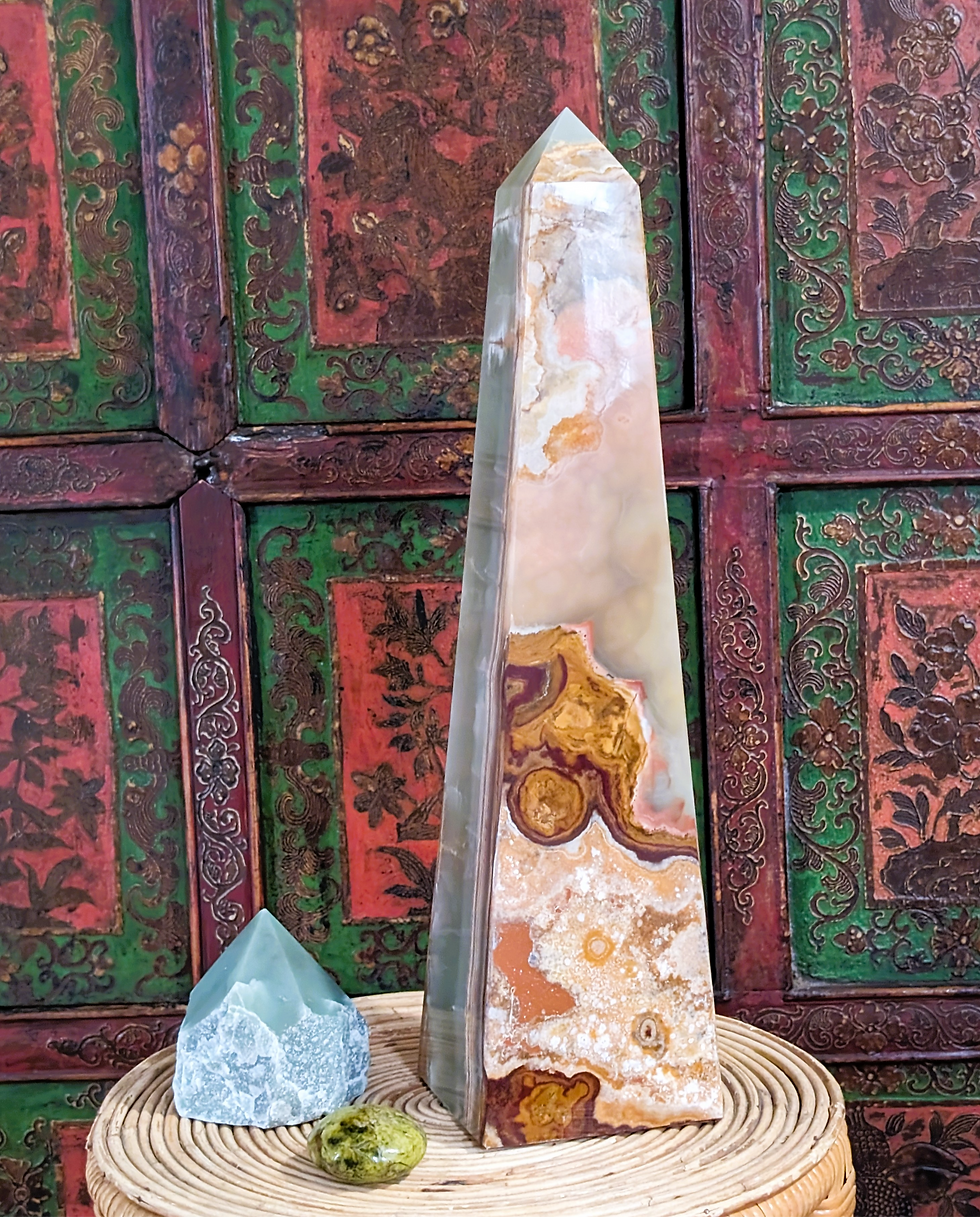
A large carving can anchor a bookshelf or console table, while smaller objects pair nicely with pottery, books, or other geological specimens. Rounded forms tend to emphasize flowing designs, whereas angular shapes offer stronger visual contrasts. Placement near a window or other light source can also bring out the stone’s translucency, creating a soft glow. Ultimately, the best location for a favorite piece may simply be wherever you enjoy looking at it.
Caring for Your Banded Calcite
Banded Calcite requires gentler handling than harder materials such as Quartz or Agate. With a Mohs hardness of 3, its surface can be scratched by common household items, and sharp impacts may damage delicate edges or carved details.

Routine cleaning is straightforward. Dust with a soft, dry cloth, using a slightly damp one when necessary, and dry the surface thoroughly afterward. Avoid abrasive cleaners and acidic substances such as vinegar or lemon juice, because calcium carbonate reacts with acids. Exposure can dull the finish or permanently etch the stone.
Banded Calcite bowls and dishes can also bring a beautiful natural touch to the dining table, whether they’re filled with fresh whole fruit or arranged as an attractive centerpiece. Their swirling bands and earthy colors make them just as appealing for entertaining as they are for everyday décor, combining practical use with natural beauty.

Final Thoughts
There’s something remarkable about the journey from a mineral deposit to a finished work of art. Long before a carver picked up a tool, nature had already done much of the creative work, forming layers that would eventually become part of a bowl, sculpture, or accent piece. The artisan’s job was to uncover what was waiting inside.
And while Banded Calcite has spent generations answering to another stone’s name, perhaps it’s time it received a little credit of its own. After all, how many rocks can claim an identity crisis and still look this good?
Visit our Onyx....er, Banded Calcite collection at jujujems.com to see what we’ve selected for the shop.
Stay Sparkly! ✨
The jujujems Team


Comments