


Fluorite: Meaning, Uses, and the Beauty of Structure & Color

Updated: Jun 19
January has a way of asking a lot from us ...
New year. New plans. New expectations.
After the rush of the holidays, the month often calls for something quieter — a pause, a reset, a chance to ease back into rhythm rather than push forward all at once. That’s where Fluorite comes in.
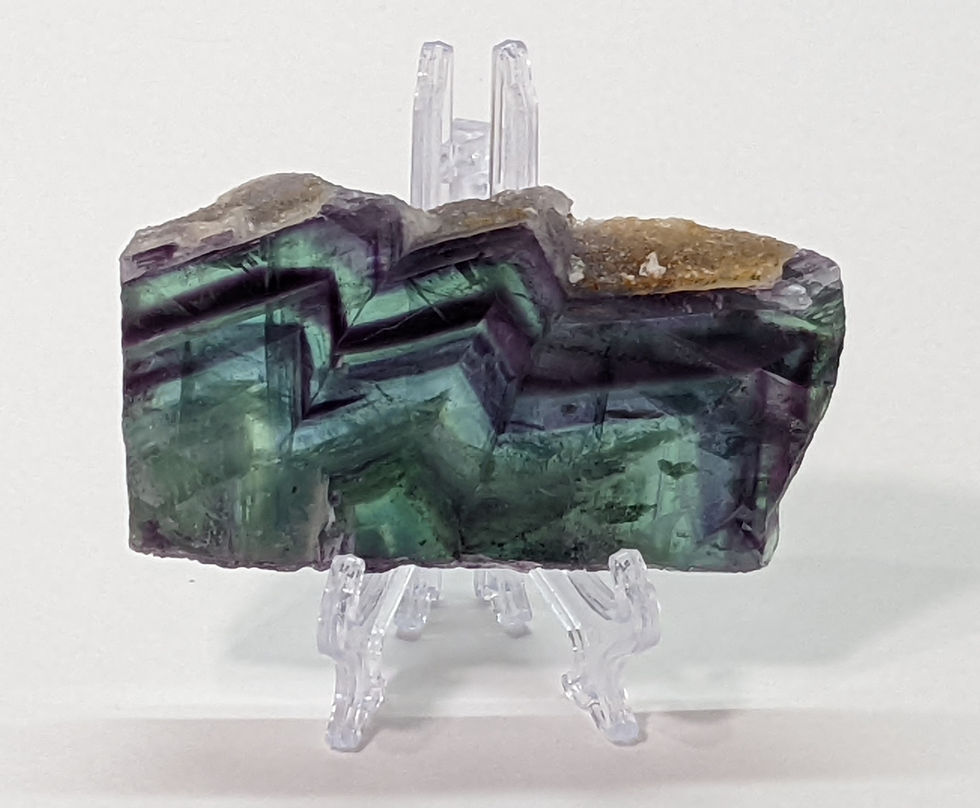
Fluorite has a way of catching your eye before you even realize why. Maybe it’s the layered bands of color — soft greens, purples, blues, and sometimes clear as glass — or maybe it’s the subtle sense of order it brings to a space. Fluorite doesn’t demand attention. It simply holds it.
As our Stone of the Month for January, Fluorite feels like the perfect choice. It’s often associated with focus, balance, and mental ease — not because it promises quick change, but because it allows steady, thoughtful momentum. In a season that benefits from calm direction rather than urgency, Fluorite meets it with grounded, reflective support.

A Stone Shaped by Time, Use, and Human History
Evidence shows that thousands of years ago, ancient civilizations carved Fluorite into decorative vessels, ornaments, and functional objects. But its appeal wasn’t only visual. Fluorite behaved in useful, predictable ways under heat and pressure, making it an important material long before modern science explained why.
The name fluorite comes from the Latin word fluere, meaning “to flow,” referring to its long-standing role as a flux. When added during metal smelting, Fluorite lowers melting points and helps impurities separate. This improved the efficiency and reliability of metal production, even before it was formally understood.
Fluorite is also known for a phenomenon that later took its name: fluorescence — the way some specimens glow under ultraviolet light due to trace elements in their structure. While this glowing effect fascinated early scientists and collectors, it also reinforced what people had long observed — Fluorite responds to its environment in clear, measurable ways.
That usefulness never disappeared. Even today, Fluorite remains essential in steel and aluminum production and is also prized in optics. High-quality Fluorite is used in camera lenses, microscopes, telescopes, and laser systems because of its low light dispersion and exceptional clarity, helping reduce distortion and improve precision.
Fluorite also plays a role in the production of hydrofluoric acid, which supports electronics manufacturing, glass etching, and chemical processing. It’s a surprisingly long résumé for a stone known for its quiet presence — proof that Fluorite has always balanced beauty with function, without needing to announce either.

How Fluorite Forms: Structure First, Color Second
Fluorite forms slowly within hydrothermal veins, where mineral-rich fluids move through cracks in the Earth’s crust. Over time, as those fluids cool, Fluorite crystallizes — often alongside quartz, calcite, and metallic ores.
What makes this process especially distinctive is Fluorite’s tendency to form cubic crystals and layered patterns. These shapes aren’t accidental — they reflect precise internal geometry, built patiently over time, with no shortcuts. This architectural growth pattern is a big part of why Fluorite feels so visually calming: the Earth itself created it with order in mind.
The result can vary from single cubes to clusters, layered deposits, or massive formations. Each variation records subtle changes in temperature, chemistry, and pressure, which is why no two pieces ever tell the same story.

Color, Variation, and Natural Beauty
Fluorite’s color range is one of its most loved qualities. The most common colors are green, purple, blue, and clear, though many pieces display multiple colors within a single crystal.
These variations come from trace elements and radiation interacting with Fluorite’s crystal lattice over time. Changes in chemistry and environmental conditions leave visible records in the stone, producing banding, zoning, and gradients that seem almost painted — yet entirely organic.
Some colors and formations are considered especially rare, such as deep red, vibrant pink, and true black Fluorite. Highly saturated rainbow specimens with sharp color zoning or unusually large, well-developed cubes are also uncommon and typically come from a small number of localities.
What makes Fluorite especially fascinating is that none of its beauty is decorative by design. Every hue and transition reflects shifting conditions deep within the Earth — proof that complexity often emerges from patience, not force.

Focus, Balance, and Mental Ease
Fluorite is often associated with focus, calm thinking, and mental organization. Many people are drawn to it when they feel scattered or overstimulated — a feeling that’s especially common at the start of a new year.
Rather than being energizing in a loud or demanding way, Fluorite works quietly. It’s described as a stone that helps sort thoughts and reduce mental noise, creating a centered state of mind. That’s why it’s commonly placed in workspaces, study areas, or anywhere concentration matters.
Even when admired purely for its form and color, Fluorite has a way of making a space feel more settled — visually and mentally — without asking for attention.

A January Stone That Sets the Tone
January doesn’t need bold declarations or instant reinvention. It asks for clarity, intention, and a gentler pace after the holiday noise. Fluorite fits that shift naturally, offering steadiness without pressure.
Whether placed near a workspace, displayed as a focal piece, or simply admired for its uniqueness, Fluorite supports a slower, more thoughtful start to the year. It echoes the kind of focus that feels sustainable, without overwhelm.
Fluorite reminds us that progress isn’t about rushing forward. It comes from alignment, patience, and choosing what truly deserves our attention.

Finding Fluorite That Speaks to You
Fluorite shows up in many forms, and part of its appeal is how differently each piece can feel. Some are polished into clean points, slices, or delicate bowls that highlight Fluorite’s geometry and color banding. Others are left raw or clustered, preserving the growth patterns deep within the Earth. Each style offers its own presence — structured or natural, bold or understated.
At jujujems.com, you’ll find Fluorite in a range of colors, shapes, and sizes — from finished display pieces to more untouched specimens. Whether you’re drawn to softer tones or dramatic rainbow banding, there’s no single “right” choice. What matters most is how it fits your space and how you feel when you spend time with it.

Choosing Fluorite is less about rules and more about trust. Sometimes the right stone stands out immediately; other times it’s the one that eventually grows on you. Either way, Fluorite has a way of finding where it belongs.
Stay Sparkly!
– The jujujems Team ✨



Comments